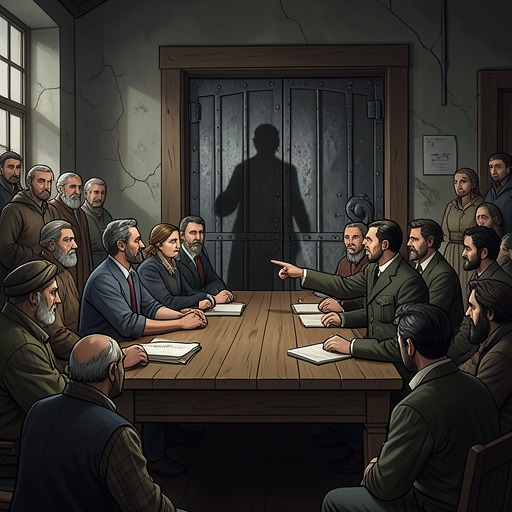
Great Benefit's denial of Donny Ray's transplant treatment
The RainmakerGreat Benefit's denial of Donny Ray's transplant treatment is the dispute that brings Dot Black and her family to Rudy Baylor and becomes the human center of their lawsuit. Great Benefit refuses to pay for a bone marrow transplant that the family says its policy covers, leaving Donny Ray without treatment his parents cannot afford. The refusal’s significance deepens as the company gives shifting explanations and the case develops from a single denied claim into a courtroom examination of its claims practices.
The family’s claim and medical stakes
Dot Black tells Rudy that she and Buddy Black bought a Great Benefit medical policy five years earlier, when their twin sons were seventeen, and had never missed a premium. Donny Ray has acute leukemia. Dot says he was diagnosed the previous August, has already undergone an initial round of chemotherapy, and has been given about a year to live. His identical twin, Ronny Ray Black, is a suitable bone marrow donor, but the procedure is estimated to cost around $150,000—far beyond what the family can pay.
The refusal is not an abstract disagreement over policy language for the Blacks. Donny Ray lives with his parents, and they are trying to secure care for him as his illness advances. Dot says the hospital stopped providing further treatment after Great Benefit said it would not cover it; the family could not fund a transplant independently. She acknowledges that the procedure is expensive, but insists that the policy promises coverage. Her account places the company’s decision between a potentially available treatment and a family without the resources to obtain it.
Changing grounds for refusal
When Rudy reviews the papers, he finds that Great Benefit has not rested on one consistent explanation. The company says Donny Ray is an adult and therefore no longer covered, although Dot has read the policy repeatedly and finds no provision ending his coverage at adulthood. Another letter calls the leukemia a preexisting condition. Dot’s account places the diagnosis roughly four years after the policy was issued, and she says the illness had been identified only months before the later refusal.
Other letters argue that bone marrow transplants are excluded or too experimental to count as acceptable treatment. Dot says her doctor examined the policy and considered the transplant routine treatment. Rudy sees an additional problem in the contract: it lists exclusions for transplants of other organs but does not specifically mention bone marrow. Great Benefit’s explanations thus shift among the patient’s age, the timing of his illness, the policy’s coverage, and the medical status of the procedure. The sequence makes the dispute look less like a straightforward application of a clear exclusion than a search for grounds to sustain a denial.
After seven written refusals, the company sends an eighth and final letter. Rather than merely restating a coverage position, it insults Dot. Rudy recognizes the letter as striking evidence of the way the company has treated the claim. At trial, Dot reads the denial letters in sequence, including the changing rationales and the final insult. The jury reacts with visible disbelief, and the courtroom falls silent when she finishes. The letter’s force comes not only from its language but from its place at the end of repeated refusals directed at a family that has kept paying its premiums.
From denied treatment to courtroom evidence
Dot describes more than the correspondence. She has sought help from public officials and local hospitals, and has tried to raise money with friends and neighbors, without finding a way to secure the transplant. At trial, she identifies the policy and application and recounts the weekly visits of agent Bobby Ott, who collected the payments. Her testimony connects the company’s paperwork to the household that bought coverage expecting protection when illness came.
The case also changes the scale of the question. Donny Ray dies before the trial testimony, and his recorded deposition is played to the jury. Edited to thirty-one minutes, it gives the jurors a sustained account from the person whose treatment the dispute concerned. Dot’s evidence and Donny Ray’s recording make the consequences of the refusal legible alongside the policy and denial letters; the insurance question is no longer only a contest between competing readings of a document.
Rudy’s trial presentation places the individual claim within the company’s wider conduct. He points to concealed documents, the testimony of Jackie Lemancyzk, and Great Benefit’s statistics on policies, claims, and denials during 1991. In closing, he describes the evidence as showing a year-long experiment in denying legitimate claims. This is the plaintiff’s case about the broader practice, not a separate explanation offered in the original letters to Dot. Its effect is to frame the Black family’s experience as part of a pattern rather than an isolated administrative error.
Consequences and significance
The denial has consequences that the correspondence itself cannot reverse: Donny Ray does not receive the transplant, and the treatment opportunity is lost before the case reaches trial. Rudy argues that the procedure was not experimental and could probably have saved Donny Ray’s life, pointing to the testimony of Dr. Walter Kord and the defense’s failure to offer contrary medical proof. The claim that coverage would have changed the outcome is therefore central to the plaintiffs’ argument, while the trial also asks the jury to judge Great Benefit’s handling of the claim and its broader conduct.
By the close of the plaintiff’s case, the jurors have heard Dot read the refusals, examined evidence about Great Benefit’s internal claims procedures, and watched Donny Ray’s recorded testimony. The company’s denial has moved through three forms: a family’s urgent request, a sequence of shifting written explanations, and evidence presented as part of a systematic practice. The supplied events stop as the case proceeds to the defense; they establish the stakes and the plaintiff’s account, but do not provide the jury’s verdict.